What Happened in the European Countries That Moved to Hourly Netting?
In Poland, installations fell from 1.3 GW to 375 MW in a single quarter. In the Netherlands the rule takes effect in 2027, yet home batteries are already up 140%. In Hungary a few weeks of commissioning date decided a decade of economics. Europe made this transition between 2021 and 2024 — four countries, and what they suggest for Turkey.
Turkey moved to hourly netting this year. Most solar owners we talk to on site open with the same question: how long will this last, will we get used to it? Honestly, it is too early to answer that with Turkish data. But several European countries made the same transition between 2021 and 2024, and what happened there is on the record.
This is not a regulation summary. We look at Poland, the Netherlands, Hungary and Belgium/Flanders, and at what those cases suggest for Turkey. Every figure below comes from public sources; we have not mixed in estimates of our own.
Poland: installation rate fell to a quarter in one quarter
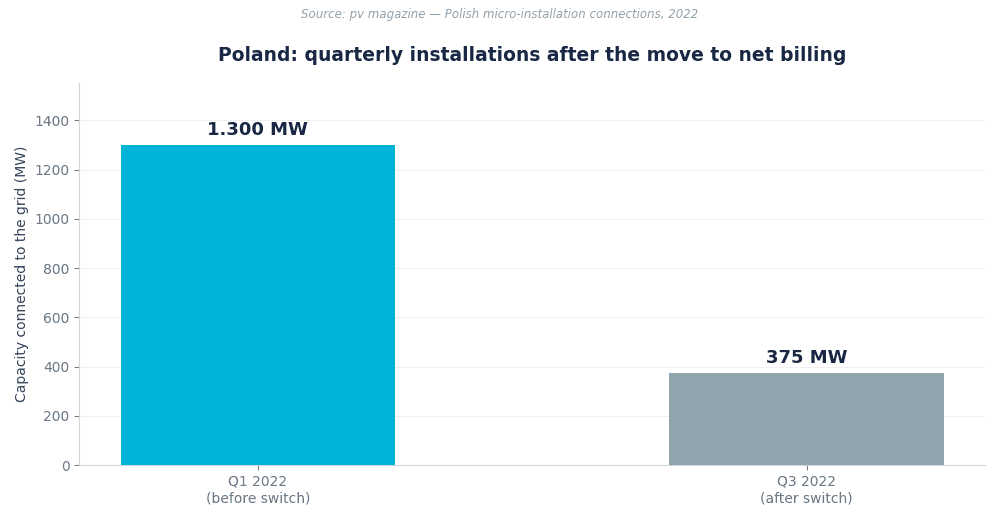
The clearest data comes from Poland. On 1 April 2022, micro-installations up to 50 kW moved from net metering to net billing.
In the quarter right before the switch, roughly 1.3 GW of micro-installation capacity was connected — about 152,000 systems averaging 8.3 kW, roughly 1,700 installations a day. By the third quarter of the same year, that figure had dropped to 375 MW.
The drop was not a permanent collapse, but it changed how the market behaved. Investors stopped thinking "install panels, push the surplus to the grid" and started looking at anything that raised self-consumption: batteries, heat pumps. Combined with the Mój Prąd support scheme, 4-5 kW systems could reach an internal rate of return in the 19-25% band. But for export-heavy systems with low self-consumption, payback stretched by 3 to 5 years.
The distinction matters: net billing did not punish the average investor. It punished the investor who did not manage their profile.
The Netherlands: the market started pricing it before the rule changed
The Dutch salderingsregeling ends completely on 1 January 2027; the law passed in December 2024. So the transition has not happened yet.
The market reacted anyway. Some suppliers have started quoting negative export tariffs — meaning you pay them to take your surplus. Home battery installations are expected to grow 140% in 2025 over 2024, while panel additions fell.
This may be the most instructive point for Turkey. **Behaviour changes on the day the rule becomes certain, not the day it takes effect.** Investors are not waiting for 2027; they are positioning now.
Hungary: protection looking backwards, sharpness looking forwards
Hungary removed net metering for new systems at the end of 2023 and moved to gross settlement: you sell surplus at a regulated price and buy what you consume at retail.
One detail carries most of the weight: systems commissioned before 31 October 2023 stayed on the old scheme until 2035. The commissioning date decided a decade of economics.
The result showed up in 2024. Residential installations fell sharply; the country landed at 1.41 GW, slightly below 2023. The industry used the word "shock"; the government argued payback was still around ten years. Both were partly right — the average held, but the picture for the below-average investor was different.
Belgium/Flanders: the transition came from a court
In Flanders the change did not come from an energy policy decision. In January 2021 the Constitutional Court annulled the reversing-meter arrangement.
From then on, consumption and injection were metered separately and a digital meter became mandatory. Existing owners received a one-off compensation guaranteeing a 5% return over 15 years.
The lesson here is institutional rather than technical: **when and how the scheme changes is not always in the regulator's hands.** Resting an investment model on the permanence of one netting rule means resting it on a variable you do not control.
The real issue is not netting — it is the value of midday
What these four countries share is not a settlement method. It is this: electricity is cheapest exactly when the sun produces most.
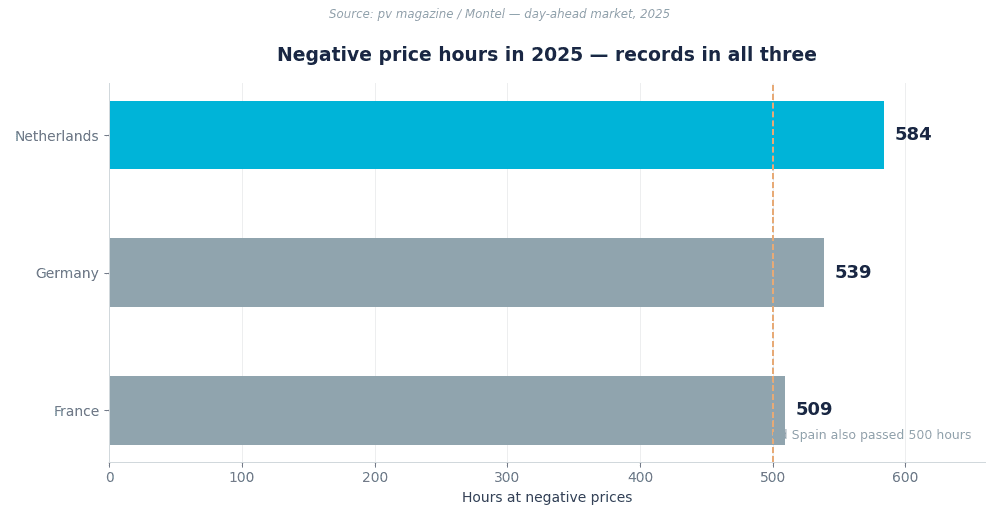
The 2025 figures are blunt. Negative price hours reached 584 in the Netherlands, 539 in Germany and 509 in France — records in all three. Sweden, Belgium and Spain each passed 500 hours. Germany curtailed 1,749.7 GWh of renewable generation that year, around 25% more than in 2024; Germany, France and the Netherlands together curtailed 3.9 TWh. Spain's installed solar went from 9 GW in early 2020 to 32 GW by the end of 2025.
Midday value erosion is not a passing market anomaly. It deepens as installed solar grows. The netting rule did not create this reality; it simply put it on the bill.
What happened on the C&I side: storage stopped being optional
Our own segment — commercial and industrial sites — moved more quietly but more steadily.
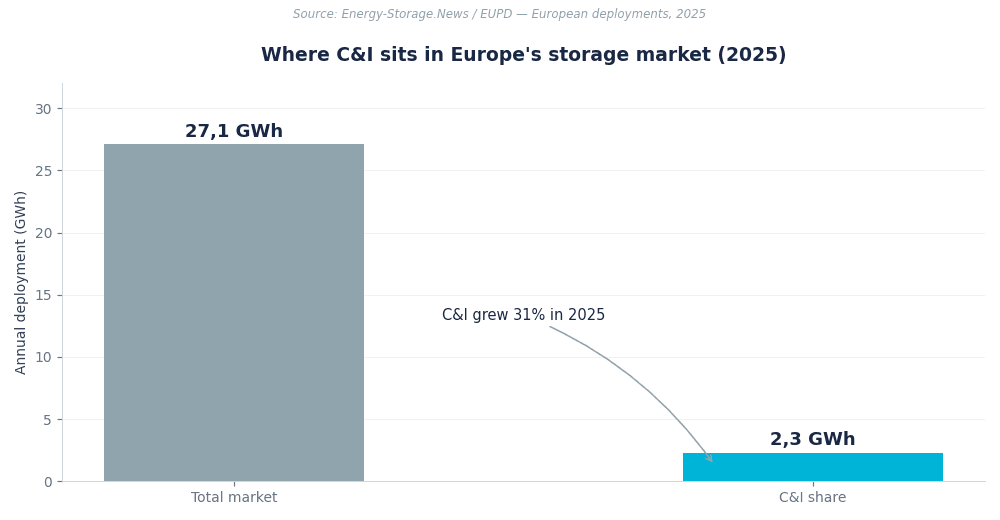
C&I storage in Europe grew 31% in 2025 to 2.3 GWh, which is 8% of the 27.1 GWh total market. By 2026, battery attach rates alongside solar were around 20% in commercial and 10% in industrial settings. Two use cases dominate: raising self-consumption and shaving peak demand charges.
Those rates being still low says the work is just starting. But the direction is not ambiguous.
What changes for a solar plant owner
A plant built on monthly netting economics does not hold the same economics under an hourly regime. The payback calculation has to be redone — which does not mean panels became a bad investment, it means the inputs changed.
The Polish data points at the variable that matters: self-consumption. Sites consuming most of their own generation were relatively insulated. Sites exporting were not.
What changes for a C&I facility
Your consumption profile is no longer only a cost line; it is an asset. How well generation and consumption overlap hour by hour now touches revenue directly.
In most facilities this is a software problem before it is a hardware one. Shifting a shift plan, a cooling load or a charging schedule against the price signal often comes before a battery investment.
What changes for a storage investor
Through these transitions, storage moved from "backup power" to "time shifting". Moving generation that loses value at midday into the evening became the mainstream strategy in Europe.
How that arithmetic settles in Turkey is still early to call. But in the other markets, the case for storage was made by price spreads, not by outages.
What changes in engineering
An hourly regime asks for something sites did not need before: a decision for every hour, every day. That cannot be made by hand — a 24-hour plan has to be rebuilt daily, for every site.
Two practical consequences. First, the plan has to execute on site; what the plant does when the cloud connection drops must be defined in advance. Second, replacing the existing installation is usually unnecessary — these decisions can be applied with the on-site inverter and logger left in place.
What Turkey can take from this
The shared conclusion across four countries: solar investment did not end in markets that moved to hourly settlement, but **the economics broke for investors who did not manage their profile.**
Three concrete takeaways.
Commissioning dates matter. In Hungary a few weeks separated two very different decades. Transitional provisions deserve careful reading in Turkey too.
Self-consumption ratio is becoming more decisive than installed capacity. What stretched Polish payback by 3-5 years was not system size; it was where the generation went.
Storage and hourly management stopped being optional in these markets. We are not offering that as a rescue — only reporting that four countries moved the same way.
Turkey's difference from these countries is that it is making the transition with their experience already visible. That is not a small advantage.
We describe how we run these decisions on site in a separate page: Hourly Netting & Dynamic Tariff.