TEİAŞ Frequency Tests: Is Your Battery Technically Ready for Ancillary Services Revenue?
TEİAŞ's (Turkish Electricity Transmission Corporation) technical criteria for energy storage define exactly what a battery must achieve to earn revenue from frequency ancillary services: 50% of the reserve in 15 seconds, a 200 ms fast response, a 5%-95% state-of-charge window, and 'provided/not provided' thresholds.
"Tests will now be conducted by TEİAŞ." This was the summary we saw in most energy bulletins in recent weeks. But for a battery investor or operator, the real question isn't "who is testing"; it's "what exactly do I need to achieve in the test?" The answer to this question is written out with specific figures in the technical criteria for the use of electricity storage units and facilities in ancillary services. And those figures determine whether a battery can truly access ancillary services revenue.
In this article, we won't repeat the general framework; we'll directly look at the technical thresholds. Because that's where the field difference arises — for the storage operator, the newly licensed generator, and the engineer installing the control software.
Primary Frequency Control Rule is Clear: 50% of Reserve in 15 Seconds, Full Reserve in 30 Seconds
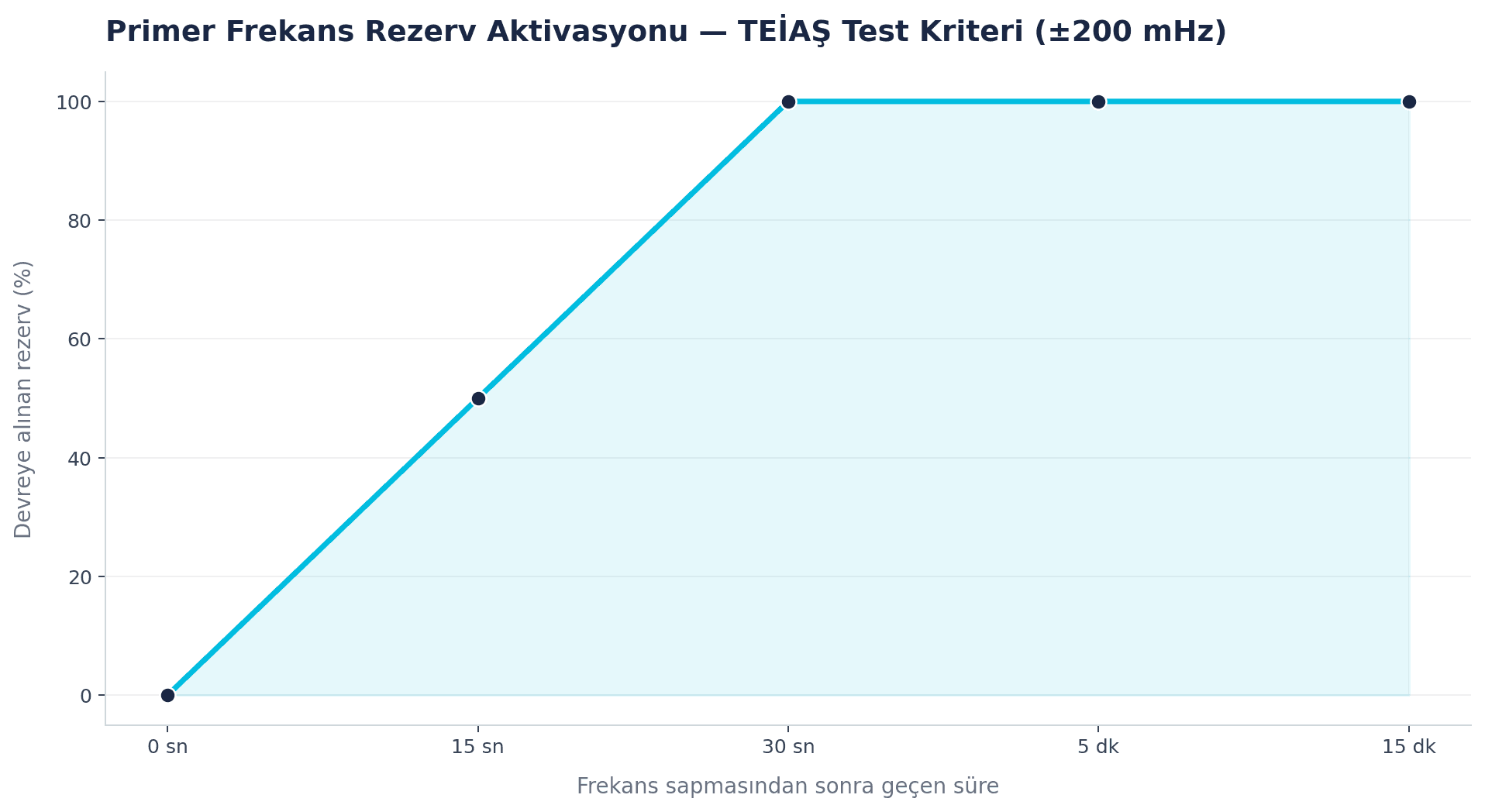
The most critical threshold is in primary frequency control. When there's a ±200 mHz deviation in system frequency, the ancillary service unit must activate fifty percent of its primary frequency control reserve within a maximum of 15 seconds, and the full reserve within 30 seconds at the latest. Furthermore, it must be able to sustain this output power for at least 15 minutes. The response delay time cannot exceed 2 seconds, and the service can be provided with a dead band of at most ±10 mHz.
What it means for you: This isn't a "set it and forget it" setting. As seen in the graph below, the activation curve needs to reach one hundred percent in the first 30 seconds and then plateau for at least 15 minutes. The battery's power (MW) as well as its energy (MWh) to sustain that power for 15 minutes are part of the test. If you commit to the reserve solely based on power and neglect the energy aspect, the test will stall precisely at this 15-minute plateau step.
Fast Frequency Control: 200 Milliseconds – Where Batteries Outperform Traditional Plants
The technical criteria require the entire reserve for fast frequency control to be activated in sub-second durations — on the order of 200 milliseconds to one second. This is a speed that thermal and most hydro assets physically cannot achieve. The battery is precisely the asset class born for this job.
What it means for you: From an investor's perspective, this points to one of the most defensible revenue streams for BESS — because most of the assets you compete with cannot reach this speed. But a 200-millisecond response is as much a matter of measurement and control as it is a hardware feature: you need to be able to prove that you can produce this speed in a manner consistent with the TEİAŞ protocol.
Operate Your Battery Between 5%–95%: Why "Usable Energy" Matters More Than Installed Capacity
In the tests, the lower limit for the battery's operational state-of-charge is set at 5%, and the upper limit at 95%. This means only approximately 90% of your nominal energy capacity is actually considered usable. If you don't size your reserve obligation according to this window, there are two risks: either the state-of-charge drops below 5% during the test, making you unable to sustain the reserve, or you participate with insufficient energy capacity from the start and receive a 'not provided' mark.
What it means for you: In the return model of storage investment, MW (power) is often discussed; however, ancillary service performance is largely a matter of MWh (energy and duration). When the 15-minute sustainment requirement and the 5%-95% window are combined, the concept of "usable energy" becomes more critical than installed capacity when sizing the battery.
Which Threshold Gets You In: 30 MW, 50 MW, 10 MW
Each ancillary service requires a different threshold in terms of installed capacity connected to the transmission system. For primary frequency control and reactive power control, an installed capacity of 30 MW and above is sought. For secondary frequency control and limited frequency sensitivity mode (SFHM), the threshold is 50 MW and above; SFHM is mandatory for storage facilities of 50 MW and above connected to the transmission system. Some frequency obligations cover facilities of 10 MW and above. For reactive power, the facility can offer capacity up to 40% of its installed power; the droop value is between 2% and 7% and is determined by TEİAŞ.
What it means for you: You should design your portfolio and — in the future, when aggregation opens up — your consolidation strategy according to these thresholds. A single 45 MW facility will be just outside the door for secondary frequency and SFHM; however, exceeding this threshold with the right design directly increases the number of accessible revenue streams.
"Provided / Not Provided / Did Not Participate": Where Performance is Measured in Money
Perhaps the most crucial aspect of the technical criteria to discuss is how performance is graded. In a settlement period, if the time the unit remains outside the tolerance band is equal to or less than 10% of the period, it is considered "provided"; if it's between 10% and 50%, it's "not provided"; and if it's 50% or more, it's "did not participate." This measurement is performed with 10 data samples per second (i.e., every 100 milliseconds) and with at least a 0.2% accuracy class.
What it means for you: Ancillary service revenue is not earned by "connecting and waiting"; it's paid in exchange for performance measured with millisecond resolution in each settlement interval. This is precisely where optimization software creates value. When making a battery's charge/discharge decision, it must simultaneously keep the frequency obligation within the tolerance band, manage the state-of-charge within the safe window, and not unnecessarily forgo arbitrage revenue. On the Pulsar (C&I) and Quasar (utility) side, we address this balance as a single optimization problem: maintaining energy revenue while staying within the "provided" band for ancillary services.
What Changes for Newly Licensed Producers and Hybrid Sites
These criteria concern not only independent BESS operators but also GES+BESS (Solar PV + Battery Energy Storage System) hybrid sites and newly licensed producers. Limits on the active output power that storage-enabled generation facilities can provide to the system and frequency obligations inherently affect how a hybrid facility is designed from the outset. Even if you don't plan to provide frequency response today, leaving the control layer on site capable of meeting these criteria will be much cheaper than going back and changing hardware when the door fully opens in the future.
Three Technical Questions Before September 1st
Before September 1, 2026, when TEİAŞ will begin conducting tests, no matter which side you're on, these three questions will clarify your plan. First: can my battery activate fifty percent of the reserve in 15 seconds and the full reserve in 30 seconds for a ±200 mHz deviation, and sustain it for 15 minutes — and can I measure and prove this? Second: did I size my reserve commitment according to the 5%-95% state-of-charge window and the 15-minute energy requirement, or just based on MW? Third: can my control layer produce records compliant with the TEİAŞ protocol at 10 data points per second and 0.2% accuracy, and stay within the "provided" band?
The ancillary services market opens up one of the most predictable revenue streams for batteries. But the key to this door is not a general feeling of "being ready"; it's proving that you can meet each of the figures above in the field. The most expensive mistakes often arise from not reading these technical thresholds in time.
We describe how we address this on the product side here: Quasar Edge.