Turkey's Energy Market Revolution: Six Months Under the Hourly Netting Regulation and Its Profound Impacts
EPDK's new hourly netting regulation in Turkey's energy market has fundamentally reshaped the landscape, particularly for renewable energy facilities. This pivotal regulation underscores the critical importance of hourly balancing and energy storage investments.

The past six months have witnessed a significant transformation in Turkey's energy market. The hourly netting regulation, introduced by EPDK (Turkey's Energy Markets Regulatory Authority), has rewritten the rules of the game, especially for facilities that generate and consume electricity from renewable energy sources. We are directly observing in the field that this change is not merely a technical detail but affects a wide range of aspects, from investment models to operational strategies. While the initial cloud of uncertainty begins to dissipate, we can now more clearly see who has seized which opportunities or encountered which challenges.
Essentially, this regulation directly impacted the financial implications of feeding excess electricity into the grid and drawing insufficient electricity from the grid, by shifting the electricity generation and consumption balance from a monthly to an hourly basis. Previously, calculations were made at the end of the month based on a single net value; now, they are shaped by instantaneous production and consumption data every hour. This situation has created a completely different optimization need, especially for facilities adopting a self-consumption model and those considering storage investments.
For Solar Power Plant (GES) Owners: How is the Monthly Bill Now Structured?
For Solar Power Plant (GES) owners, hourly netting has become a critical parameter directly affecting their operational economics. Previously, excess electricity generated during the day, for example at noon, would be netted against periods of high consumption in the evening, and revenue would be recorded based on a unit price. With the new regulation, this situation has changed: production and consumption are matched for each hour. The matched portion remains as a true net-off, a meter-side credit (no pricing is applied). Any surplus generated during hours when production exceeds consumption, up to the annual consumption amount, is purchased at the lowest single-rate active energy tariff of the subscriber group. For the portion exceeding annual consumption, the same tariff applies, but this time, system usage fees are passed on to the producer. Energy drawn during hours when consumption exceeds production is billed at the subscriber group's active energy tariff + distribution fee + (if applicable) capacity fee + reactive power fee.
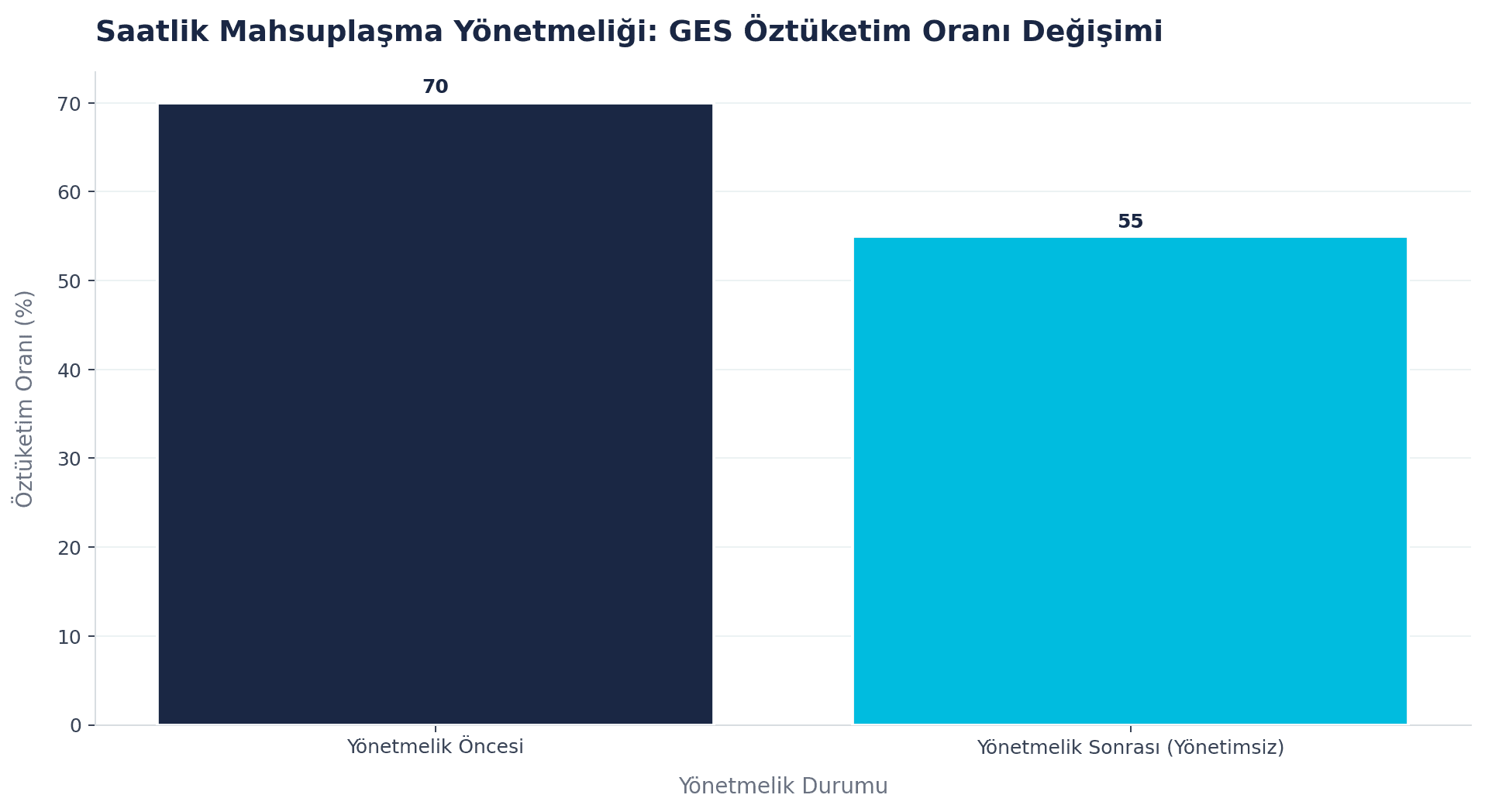
This change is particularly significant for residential or small commercial businesses that have installed GES on their roofs. Previously, balancing could be achieved by consuming excess energy generated during the day at night. Now, however, the production surplus generated during the day, especially at noon, does not directly net off against nighttime consumption. This situation requires a more dynamic approach for instantaneous management of the self-consumption rate and maximizing potential grid sales revenue. The monthly bill of a small-scale rooftop GES is now much more sensitive to the instantaneous production-consumption profile throughout the day. For example, for a typical 10 kWp rooftop GES owner, while the self-consumption rate, which was 70% before the regulation, could drop to 55-60% without instantaneous management, the revenue obtained from energy fed into the grid might not reach the expected return.
For C&I Facilities (Self-Consumption Focused): Why Have Storage Investments Become Critical?
For Industrial and Commercial (C&I) facilities—structures focused on self-consumption such as factories, shopping malls, and large office buildings—hourly netting has virtually made Battery Energy Storage Systems (BESS) a mandatory investment. These facilities typically have a high and variable electricity consumption profile. While they can achieve a daytime production surplus with the GES installed on their roofs or land, they often need to draw electricity from the grid during evening or nighttime hours.
Before the new regulation, these imbalances could be managed more flexibly at the end of the month thanks to monthly netting. However, with hourly netting, the balance in each hour has become critical. If a C&I facility produced 500 kWh of excess electricity from its GES at noon and fed it into the grid, but then had to draw 300 kWh of insufficient electricity in the evening, it could previously net off these two transactions. Under the hourly regime, by not being able to net these two, it will both fill its paid production limit faster and also pay system usage fees for the 300 kWh drawn in the evening. This situation leads to financial losses.
This is where BESS comes into play. An energy storage system can store excess electricity generated during the day and meet consumption deficits during evening or nighttime hours from its own reserves. Thus, the facility avoids both selling electricity to the grid at a low price and buying electricity at a high price. This strategy maximizes the facility's self-consumption rate while also optimizing its energy costs. For example, a typical production facility can increase its self-consumption rate from 75% to 90% with a 2 MWp GES and 1 MWh BESS investment. This could translate into savings of up to 15-20% on the monthly electricity bill. The comparison below clearly demonstrates the financial profile of a typical C&I facility before and after hourly netting and the impact of BESS integration.
Opportunities and Risks for BESS Investors and Storage Operators
For those investing in or operating Battery Energy Storage Systems (BESS), the hourly netting regulation has opened the doors to new business models. While areas like balancing services or the capacity market were previously prominent, direct self-consumption optimization has now become crucial. Storage operators can manage hourly production and consumption imbalances, especially by working with large-scale C&I facilities or portfolios with multiple GES.
If prices were calculated based on PTF (Day-Ahead Market Price) and PSF (System Marginal Price) instead of EPDK's monthly fixed tariff tables, an arbitrage opportunity could also arise. The fact that this pricing is not high enough to cover storage costs (investment, operation, efficiency losses) makes risk management and accurate price forecasting algorithms critical. Furthermore, TEİAŞ (Turkish Electricity Transmission Corporation)'s grid constraints and changes in balancing mechanisms also require BESS investors to continuously review their strategies. The relevant articles of EPDK's Storage Facilities Regulation and market operating rules continue to shape the risks and opportunities in this area. According to forecasts, a significant portion of the over 5 GW of storage capacity expected to be commissioned in Turkey within the next 3 years is anticipated to be positioned according to these new market dynamics.
Engineering and Software Layer: The Rise of Smart Management Systems
The hourly netting regulation has exponentially increased the importance of Energy Management Systems (EMS) and Distributed Energy Resource Management Systems (DERMS). It is no longer sufficient for a GES or a hybrid system to merely operate technically; it must also be economically optimized. At this point, smart software solutions with data collection, analysis, forecasting, and decision-making capabilities have become indispensable. On the engineering side, providing instantaneous data flow from facility SCADA systems, processing this data, and accurately forecasting future production-consumption profiles is a major challenge. Determining the optimal strategy for when a BESS should charge and discharge requires advanced algorithms, integrating many variables such as weather data, historical consumption patterns, and market prices. Algorithmic platforms like E-Hub provide instantaneous decisions to facility operators or automatic control systems by performing these complex calculations.
In the software layer, N2N's products like Pulsar (C&I DERMS) and Quasar (utility grid) respond to the needs of this new era. These systems not only monitor energy flow but also automatically optimize BESS charge/discharge cycles by forecasting market prices and facility needs with machine learning-based prediction models. For example, our Pulsar Edge devices process instantaneous data at the field level, managing the energy to be fed into the grid or storage capacity in the most efficient way. This reduces the need for manual intervention by engineering teams while increasing the facility's financial performance. This new dynamic brought by hourly netting has once again become a critical area where energy engineering and software development intersect.
The Period Ahead and Future Outlook
The hourly netting regulation is a significant milestone in Turkey's energy market's journey towards a more transparent, dynamic, and efficient structure. The past six months have shown that the adaptation process is rapidly continuing and the need for smart energy management solutions is increasing. We anticipate that the transformation triggered by this regulation will deepen and continue in the coming period.
For GES and BESS investors, C&I facilities, and energy engineers, this new balance will require continuous learning and adaptation. For those seeking a competitive advantage in the market, investing not only in hardware but also in smart software and algorithms to manage that hardware most efficiently has become inevitable. The 'mathematics' of the energy market is now more complex, and those who can correctly interpret this mathematics will lead in the energy ecosystem of the future. During this period, as a GES owner, it is beneficial to ask yourself these three questions: What steps am I taking to maximize my instantaneous self-consumption rate? How can I accelerate the return on my storage investment? And most importantly, do I have a smart software solution to manage this complex equation for me?
We describe the solution that runs this equation for you on site in detail here: Hourly Netting & Dynamic Tariff.