Targeted Production in Hybrid PV+BESS: Revenue Optimization with Smart Algorithms
Achieving committed production targets in hybrid PV+BESS systems is not only a technical necessity but also a critical factor directly impacting a business's revenue model. This article explores how smart control algorithms, through the integration of PV and BESS, can help achieve these targets consistently and economically.
We recently had the opportunity to be on-site during the commissioning of a client's hybrid PV+BESS project. One of the facility's most critical expectations was to meet committed production targets to the grid at specific times of the day. This isn't just a technical requirement; it's a parameter that directly influences the business's revenue model. With the integration of storage in hybrid systems, the concept of "Targeted Production" has begun to play a central role, especially in grid connection agreements and energy market participation. So, when PV and BESS are at the same point of connection, how can we consistently and economically meet this target? The answer to this question lies in smart control algorithms.
Hybrid PV+BESS Systems: Why is Targeted Production So Important?
In the energy sector, especially with the increasing share of renewable resources, managing production fluctuations is becoming increasingly complex. While solar power plants (PV) offer variable production profiles throughout the day, Battery Energy Storage Systems (BESS) play a critical role in balancing this fluctuation and providing flexibility. Hybrid PV+BESS systems bring these two technologies together, increasing production continuity and offering a more predictable and controllable energy flow to the grid.
Targeted production is one of the most important parameters defining these systems' interaction with the grid. For example, an energy market participant might commit to supplying 10 MWh of energy to the grid within a specific hour. If the PV's current production doesn't meet this commitment, the BESS steps in to cover the difference. Conversely, if the PV is over-producing, the BESS can store this excess energy for future needs or discharge it when the grid needs it most. This flexibility is vital for both grid stability and the commercial operations of the facility.
For PV Owners: The Role of Targeted Production in Monthly Revenue Statements
For a PV owner, a targeted production algorithm is an optimization tool that directly impacts their financial statements. Especially in next-generation grid connection agreements, providing regular and predictable energy to the grid in exchange for a specific capacity allocation is expected. If the PV's instantaneous production fails to meet this target, penalties may be incurred, or opportunity costs may arise. BESS integration can minimize these risks.
In a typical scenario, the PV owner commits to a specific production band to the grid, either a day in advance or on an hourly basis. During peak solar hours, the PV alone can easily exceed this target. This is where smart algorithms come into play: * **Store excess energy:** PV production exceeding the target is directed to the BESS. This prevents unnecessary excess energy from being fed into the grid while ensuring the battery is charged for less sunny hours or evening peak times. * **Support when below target:** In situations like cloud cover, sunset, or low irradiation, PV production may drop. The BESS discharges its stored energy to prevent falling below the target production.
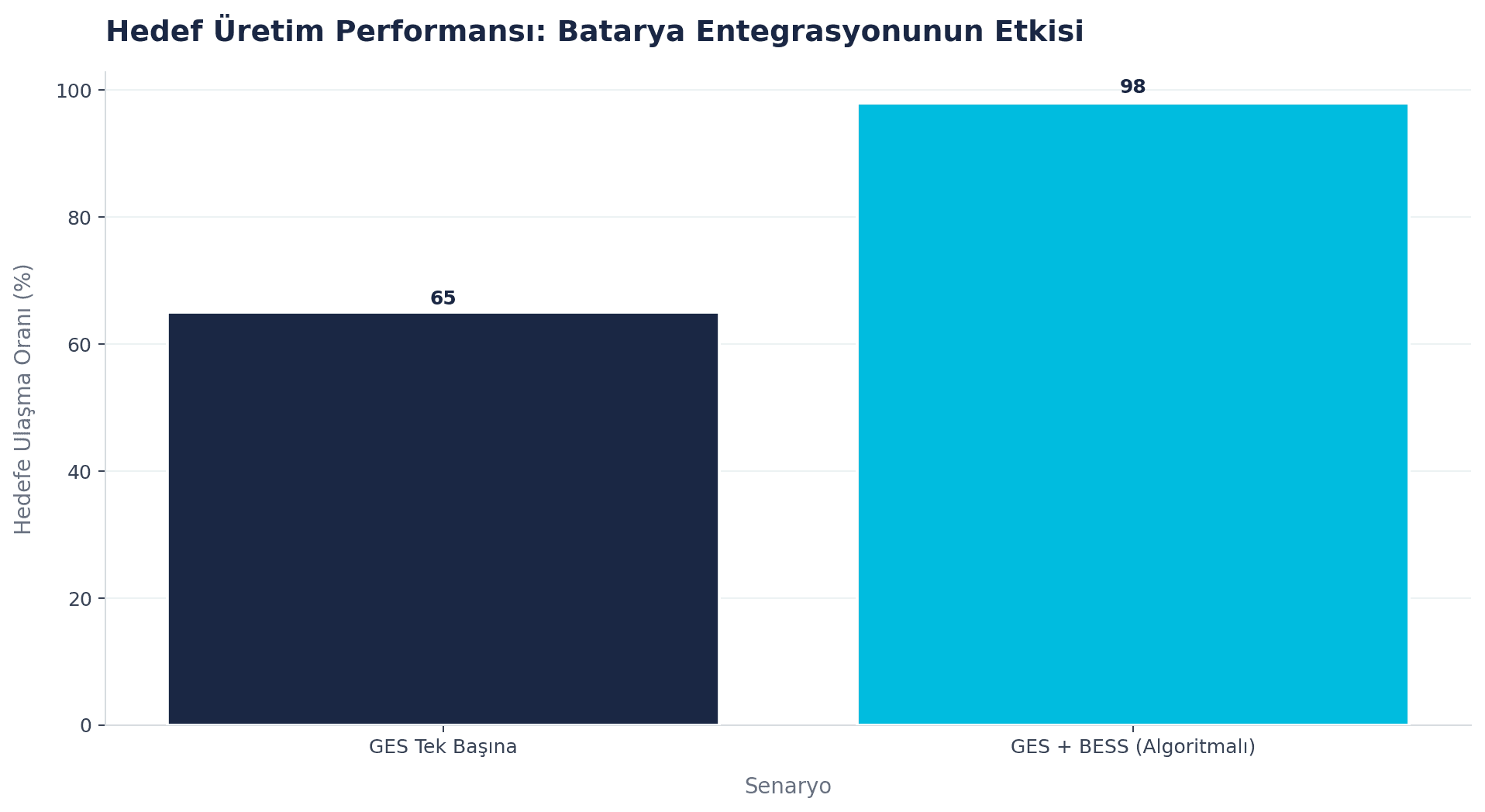
Through this dynamic management, the PV owner both complies with grid agreements and optimizes the battery's charge/discharge cycles to achieve the highest return. For instance, for a typical 20 MWp PV, meeting an hourly production target with a 5% deviation tolerance without BESS might be possible with 60% probability, whereas with a 5 MWh BESS, this rate can exceed 90%. This could mean a 15-20% increase in monthly revenue or avoidance of penalty fees.
For C&I Facilities (Self-Consumption Focused): Tangible Reductions in Energy Bills
For industrial and commercial (C&I) facilities, hybrid PV+BESS systems offer the potential to optimize self-consumption and reduce the cost of energy drawn from the grid. Here, the concept of "targeted production" refers not to a commitment to supply energy to the grid, but rather to the goal of meeting the facility's internal consumption and managing peak demand load.
DERMS (Distributed Energy Resources Management System) software like Pulsar analyzes the energy profiles of C&I facilities to determine the most suitable charge/discharge strategies. Targets typically include: * **Peak shaving:** Identifying the facility's highest electricity draw moments (peak demand) during the day, discharging the BESS at these times, and reducing the power drawn from the grid. This provides significant savings, especially with time-of-use tariffs and capacity charges. * **Tariff optimization:** Charging the BESS during hours when electricity is cheap and discharging it when it's expensive to perform arbitrage. * **Uninterrupted power supply:** Providing backup power for critical loads during short-term outages.
For example, a factory with a monthly electricity bill of 500,000 TL (approximately $15,000 USD) could see a reduction of up to 75,000 TL (approximately $2,250 USD) in its monthly bill by saving 30% on peak demand charges and 10% on energy unit prices, thanks to a 2 MWp PV and 2 MWh BESS integration managed by a smart targeted production algorithm. This significantly shortens the investment's payback period.
For BESS Investors: Arbitrage and Capacity Market Opportunities
For an independent BESS investor or storage operator, targeted production is directly linked to their revenue model. In this segment, BESS is not just a balancing element but also an active revenue source. Investors aim to generate income through flexibility services offered to the grid, participation in capacity markets, and energy arbitrage.
Regulations such as EPDK's (Energy Market Regulatory Authority) Regulation on Electricity Generation Facilities with Storage clarify the role of BESS in energy markets. For these investors, targeted production algorithms optimize the following: * **Day-Ahead Market (DAM) and Intra-Day Market (IDM) participation:** Maximizing arbitrage revenue by creating optimal charge/discharge plans based on price signals. * **Ancillary services (frequency control, voltage regulation):** Generating additional revenue by responding quickly when the grid needs it. * **Capacity market:** Receiving regular payments by offering a specific power capacity to the grid.
BESS investors, using algorithms like Quasar under the E-Hub umbrella, evaluate numerous variables simultaneously, such as market price forecasts, grid needs, and battery life, to determine the most profitable targeted production strategy. This optimizes the battery's cycle life while maximizing financial returns. The graph below illustrates how a targeted production algorithm optimizes the BESS charge/discharge profile over a typical day. It clearly shows how excess PV production during midday hours is stored and then fed into the grid during evening peak hours, thereby increasing arbitrage revenue.
On the Engineering and Software Side: AI Model or Heuristic?
At the heart of a targeted production algorithm lies software that makes optimal decisions by considering the system's instantaneous state, future predictions, and operational constraints. Two main approaches stand out in this area: heuristic-based algorithms and Artificial Intelligence (AI) / Machine Learning (ML) models.
**Heuristic-based algorithms:** This approach relies on a predefined set of rules and conditions. For example: "If PV production exceeds the target by 10%, charge the BESS," "If the battery's state of charge (SOC) drops below 20%, charge from the grid." * **Advantages:** Simple, easy to understand, low computational cost, quick to implement. * **Disadvantages:** May make suboptimal decisions in complex scenarios, struggles to adapt to external factors (weather, market price fluctuations), may require separate manual fine-tuning for each facility.
**Artificial Intelligence (AI) / Machine Learning (ML) models:** This approach learns from historical data to predict future production, consumption, and prices. Then, a decision-making mechanism (e.g., reinforcement learning or optimization algorithms) uses these predictions to optimize the battery's charge/discharge cycles. E-Hub algorithms combine prediction models and optimization engines to manage this complex decision-making process. * **Advantages:** High-accuracy predictions, adaptability to complex and dynamic environments, long-term optimization (including battery life), potential for higher financial returns. * **Disadvantages:** High data requirements, higher computational cost, requires expertise for model training and validation, can be difficult to explain due to the "black box" effect.
In our algorithms developed under the TÜBİTAK 1501 SEGP project, we use Machine Learning models specifically for price predictions in day-ahead and intra-day markets, while adopting a hybrid approach for real-time grid constraints and battery state management by integrating heuristic rules. This has allowed us to achieve both flexibility and improved performance. In a typical scenario, an ML-based model can provide 5% to 15% higher arbitrage revenue compared to a heuristic approach, while operating with 2% to 5% less degradation on battery life.
The Future of Hybrid Systems in the Coming Period
The Turkish energy market is undergoing a major transformation with the integration of storage technologies. Recent regulations by EPDK (Energy Market Regulatory Authority) are paving the way for hybrid systems, offering new opportunities for both producers and investors. In the coming period, targeted production algorithms and smart energy management systems will play a key role in the efficient and profitable operation of these systems.
In this dynamic environment, as a PV owner, it's beneficial to ask yourself these three questions: 1. How can my existing grid agreements become more advantageous with storage integration? 2. What is the self-consumption optimization potential of my facility, and how much can I save with a battery? 3. Which software solutions do I need to optimize battery life in the long term while maximizing financial returns?
As N2N, with our products like Photon, Pulsar, and Quasar, we will continue to provide efficient and profitable energy management solutions, supported by smart algorithms, to all stakeholders in the energy sector. The energy systems of the future are being shaped by the combination of mathematics and engineering.
We describe how we address this on the product side here: Solar + Battery Monitoring.