EPDK Hourly Netting: Opportunities and Solutions for C&I Businesses
EPDK's new hourly netting system complicates energy bills for C&I businesses but offers cost improvement potential through BESS and smart software. This article details the impacts and opportunities of these changes.

EPDK Hourly Netting: Opportunities and Solutions for C&I Businesses
One of the most discussed topics in Turkey's energy market recently is the hourly netting application implemented by the Energy Market Regulatory Authority (EPDK). This new regulation, particularly for Commercial and Industrial (C&I) businesses, has the potential to profoundly affect both their current operations and future energy strategies. During a conversation with the energy manager of a manufacturing facility in an Organized Industrial Zone (OSB) a few weeks ago, we focused on the uncertainties and opportunities brought about by this new system. "Our bills have become much more complex now," he said. "But at the same time, with the right strategy, we have a chance to see significant improvements in our energy costs." In this article, we will delve into the effects of the EPDK's hourly netting application on C&I businesses, potential losses, and how we can turn these into opportunities with Battery Energy Storage Systems (BESS) and smart energy management software, with technical details.
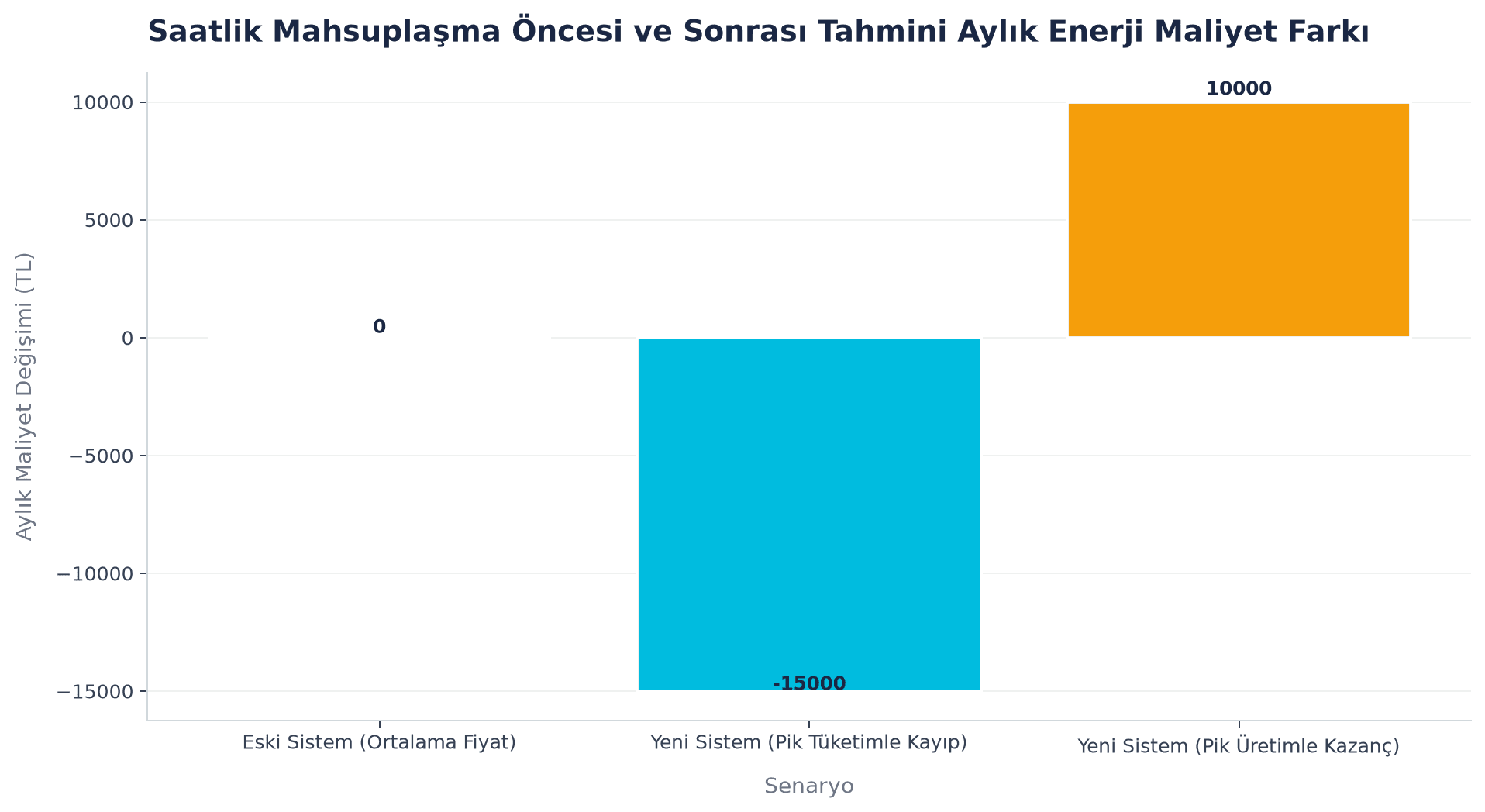
The New Billing Logic for C&I Businesses: How is Loss Measured?
Before hourly netting, energy bills for C&I businesses were typically calculated based on the total monthly consumption. This somewhat softened the impact of fluctuations in energy prices throughout the day. However, with the new system, the cost of energy drawn from or supplied to the grid during each hourly interval is calculated separately based on the market price at that hour. This can lead to significant differences, especially during hours of high consumption and/or excess production.
Consider a typical C&I facility: Energy draw is high between 09:00 and 17:00 during the day when production activities peak. In the evening, consumption decreases as production declines. If this facility has installed a Solar Power Plant (GES) on its own rooftop or land, it may supply surplus energy produced during midday to the grid. In the old system, this surplus energy was deducted from the total monthly consumption, reducing the bill. In the new system, if the market price is high during the day, selling this surplus energy can be more profitable, while supplying energy to the grid during hours when the market price is low can lead to losses.
So, how is this "loss" or "gain" measured? First, the facility's own GES production profile and consumption profile must be compared on an hourly basis. For example, a factory consumes an average of 1 MWh (Megawatt-hour) per day and produces 500 kWh (Kilowatt-hour) from its own GES during midday. If this 500 kWh production occurs between 13:00-14:00, when the market price is highest, and this energy is supplied to the grid, its monetary equivalent should be calculated. Similarly, if the facility's consumption continues during evening hours when the market price is very high (e.g., 19:00-20:00), the cost of consumption during these hours will be billed accordingly.
**Estimated Loss Calculation Scenario (Monthly Basis, for a Factory with 1 MWp GES):**
* **Current Situation (Before Hourly Netting):** Average of 500 kWh surplus production per day for 30 days a month. This energy is deducted from the total monthly consumption. This means an annual reduction of 180 MWh. * **New Situation (After Hourly Netting - Scenario 1: Unoptimized):** Same 180 MWh surplus production, but with variable market prices. If 60% of this production occurs during low-price hours (e.g., average 1.5 TL/kWh) and 40% during high-price hours (e.g., average 3 TL/kWh): * Energy supplied during low-price hours: 180 MWh * 0.60 = 108 MWh. Cost: 108,000 kWh * 1.5 TL/kWh = 162,000 TL. * Energy supplied during high-price hours: 180 MWh * 0.40 = 72 MWh. Cost: 72,000 kWh * 3 TL/kWh = 216,000 TL. * **Net Loss (Low Sales Value):** In this case, supplying surplus production to the grid may generate less revenue than before or even result in a loss. If it were possible to store this surplus production and use it during higher-priced hours, instead of potentially earning 270,000 TL with an average cost of 1.5 TL/kWh for 180 MWh * 1.5 TL/kWh, a potential revenue of 540,000 TL could be achieved at 3 TL/kWh for 180 MWh * 3 TL/kWh. The difference indicates the potential gain area. * **New Situation (After Hourly Netting - Scenario 2: Optimized with BESS):** If this 180 MWh surplus production is stored in a BESS system and managed to be consumed within the facility during evening hours when the market price is highest (e.g., between 19:00-22:00), the amount of energy drawn from the grid by the same facility decreases. In this case, a saving potential of around 180 MWh * 3 TL/kWh = 540,000 TL is created. This represents an improvement of 270,000 TL compared to the unoptimized scenario.
4 New Realities Faced by GES Owners on the Ground
Hourly netting introduces a completely new dynamic for businesses with their own GES. Now, not only producing but also **when** the energy is produced and **when** it is consumed becomes critical.
1. **Importance of Production Timing:** GES plants that produce at peak during midday, if they do not store this energy or consume it instantaneously within their own facility, may see reduced expected revenue by supplying it to the grid during low market price periods. Surplus produced during the brightest hours of the sun is no longer an automatic source of profit; it becomes a resource requiring intelligent management. 2. **Increased Need for Storage:** This situation makes BESS investments more attractive. By storing surplus energy produced, it's possible to reduce energy drawn from the grid during high market price hours and generate additional revenue by selling stored energy. This can improve the payback period (ROI) of GES. 3. **Optimization of Consumption Profile:** Businesses have the potential to shift their own energy consumption to hours when market prices are low. For example, some high-energy-consuming production processes or charging operations (like electric vehicle charging stations) can be planned for cheaper hours of the day. This is called "demand-side management" and becomes more meaningful with hourly netting. 4. **Role of Software and Automation:** Manually managing all these optimizations is nearly impossible. Tracking fluctuating market prices throughout the day, analyzing production and consumption data in real-time, and managing BESS accordingly necessitates advanced energy management systems (EMS) and DERMS (Distributed Energy Resource Management System) software. Solutions like N2N's Pulsar platform are designed to manage this complexity.
The New Math for BESS Investors: How to Maximize Gains?
EPDK's hourly netting application is rewriting the rules of the game for BESS investors. The role of BESS is no longer limited to grid balancing or providing uninterrupted power; it also prominently includes generating direct financial returns by leveraging market price arbitrage (price differences).
Key strategies for a BESS investor may include:
* **Charge-and-Discharge Arbitrage:** Charging the BESS during the cheapest energy hours and discharging it during the most expensive hours. This is the most basic and common strategy. For example, a BESS charged at midnight when the market price is 0.8 TL/kWh can provide a gross profit of 2.2 TL per kWh by discharging at 19:00 when the market price rises to 3 TL/kWh. The efficiency of storage systems (around 85-90%) and self-consumption will slightly reduce this gain. * **Hybrid Operation with GES:** BESS systems integrated with existing or newly installed GES plants can store surplus energy produced by GES and use it within the facility or sell it to the grid during high market price periods. This increases GES revenue while also creating an additional revenue stream for BESS. * **Peak Shaving:** Avoiding high energy costs during "peak" hours when C&I facilities have their highest consumption by supplying energy from BESS. Some tariffs include a "demand charge," which is determined by the facility's highest instantaneous power draw in a month. BESS can provide significant cost advantages by limiting these peak demands. * **Frequency and Voltage Regulation Services:** Generating additional revenue for BESS by participating in market mechanisms such as secondary and tertiary cycle services offered by EPİAŞ (Energy Exchange Istanbul). These services require the ability to respond quickly to maintain grid stability, and BESS are quite effective in this regard.
**BESS Profit Scenario: A 1 MW / 2 MWh System (Estimated Monthly Return):**
* **Scenario A (Arbitrage Focused):** * Average charging cost: 1.5 TL/kWh * Average discharging price: 2.5 TL/kWh * 1 full cycle per day (2 MWh) * Working days per month: 25 * Gross Profit: (2.5 - 1.5) TL/kWh * 2000 kWh/cycle * 25 days/month = 50,000 TL * Net profit after deducting system losses (15%) and operational costs. * **Scenario B (Hybrid GES + Arbitrage):** * Storing surplus energy from GES and using it during high market price hours within the day. * This strategy, in addition to direct grid purchase/sale arbitrage, also increases GES revenue. If the annual production of GES is 1,500,000 kWh and 20% of it (300,000 kWh) can be optimized with BESS and used at a higher price, this represents an additional revenue potential of 300,000 kWh * (3 - 1.5) TL/kWh = 450,000 TL.
These scenarios demonstrate how a powerful financial tool BESS can become with hourly netting. However, fully realizing this potential requires intelligent software solutions.
What is Changing on the Engineering and Software Side?
Hourly netting is not just an economic and regulatory change; it also necessitates significant adaptations in engineering and software fields. While traditional SCADA (Supervisory Control and Data Acquisition) systems may be sufficient for real-time data collection and basic control functions, the new dynamics require more advanced solutions.
This is where platforms like N2N's Pulsar (C&I DERMS) come into play. Such systems don't just collect data; they also:
* **Advanced Forecasting:** Forecasting solar production, wind production (if any), and facility consumption with high accuracy on an hourly, even minute-by-minute basis. These forecasts are critical for determining BESS charge/discharge strategies and optimizing market orders. Our E-Hub algorithms continuously improve these forecasting capabilities. * **Real-Time Optimization:** Dynamically adjusting the BESS operating mode (charge, discharge, standby) based on real-time market price changes, production data, and consumption demands. This may require millisecond-level precision. * **Market Order Management:** Automatically generating and managing buy/sell orders to be sent to EPİAŞ. This ensures buying and selling the right amount of energy at the right time and avoiding penalties. * **Portfolio Optimization:** If a business has GES and/or BESS facilities at multiple locations, consolidating all these assets under one umbrella to maximize the overall performance of the portfolio. Pulsar enables centralized management of these distributed assets. * **Compliance and Reporting:** Ensuring compliance with all regulatory requirements set by EPDK and EPİAŞ and automatically generating necessary reports.
**Software as a Data Analysis and Decision-Making Tool:**
The following comparison illustrates the potential financial performance of a C&I facility before and after hourly netting, without and with BESS and smart software integration. This graphic highlights how critical data-driven decisions are.
*(At this point, in the middle of the article, a reference to a graphic should be made with a statement like: "As can be seen from the comparison below, BESS and smart software integration not only compensates for the cost increase brought about by hourly netting but also offers significant additional earning potential. In an unoptimized scenario, the facility's monthly energy cost increases, while with a DERMS platform like Pulsar and integrated BESS, this cost can be reduced and additional revenue can be generated." The graphic should focus on monthly net cost/earnings; one column should be "Unoptimized C&I," and the other should be "Optimized C&I with BESS + Pulsar." With estimated data, it should show that costs increase in the unoptimized scenario and significant savings and even positive earnings are achieved in the optimized scenario.)*
For example, for a factory with 1 MWp GES and an annual consumption of 1,000,000 kWh:
* **Unoptimized (GES Only, Old System):** Average monthly cost 50,000 TL. * **Unoptimized (GES Only, New System):** Average monthly cost may increase to 65,000 TL (due to surplus production being supplied to the grid during low-priced hours). * **Optimized with BESS + Pulsar (New System):** Average monthly cost can be reduced to 30,000 TL, and an additional 15,000 TL in arbitrage revenue can be earned. This means a total cost reduction from 50,000 TL to 30,000 TL per month and an additional 15,000 TL in revenue.
These figures are average values and may vary depending on the facility's consumption profile, GES production efficiency, BESS capacity, and market price fluctuations. However, the core message is clear: Smart software and storage integration are key to gaining a competitive advantage during the hourly netting period.
Looking Ahead: Being Part of This Transformation
EPDK's hourly netting application signifies a major paradigm shift in the Turkish energy market. This is not just a regulatory change but also the beginning of an era where our ways of energy production, consumption, and management are being reshaped. For C&I businesses, this means both potential cost increases and opportunities to increase operational efficiency and create new revenue streams.
For C&I owners who want to succeed in this transformation, the steps to take are:
1. **Analyze Your Current Situation:** Analyze your facility's consumption profile in detail on an hourly basis. Review your GES production data hourly. At which hours do you consume the most? At which hours does your GES produce a surplus? 2. **Calculate Potential Loss:** Estimate how your current operations will be financially affected by hourly netting. Will it be a cost increase or a decrease in revenue? 3. **Evaluate BESS and Smart Software Solutions:** Research the feasibility of BESS investment and advanced energy management software (DERMS) to compensate for potential losses and even turn them into profit. Solutions like N2N's Pulsar platform offer the analytical and control capabilities needed to manage this complexity. 4. **Understand Tariff Structures:** Familiarize yourself with the different tariffs and services offered by EPİAŞ and distribution companies. Learn which market mechanisms you can benefit from.
Hourly netting is an indicator of the shift from being "passive" to "active" and "smart" in energy management. Businesses that will succeed in this new era are those that understand data, utilize technology effectively, and can quickly adapt to dynamic market conditions. As N2N, we aim to make energy work for you with mathematical certainty and intelligent automation, by standing by businesses during this transition process. It's time to optimize every hour of your energy.
We describe the solution that runs this equation for you on site in detail here: Hourly Netting & Dynamic Tariff.