Uncovering the Hidden Costs of C&I BESS Investments: 5 Factors Extending Payback Periods
As interest in Battery Energy Storage Systems (BESS) grows among Commercial & Industrial (C&I) facilities in Turkey, investors often overlook hidden costs that can significantly prolong a project's payback period. This article examines 5 frequently missed cost items and their financial implications for BESS investments, particularly for factory owners in Organized Industrial Zones (OIZs).
Over the past quarter, interest in Battery Energy Storage Systems (BESS) for Commercial & Industrial (C&I) facilities in Turkey has surged. Factory owners, especially those in Organized Industrial Zones (OIZs), are closely examining this technology for its potential to both reduce energy costs and increase grid independence. However, in our field discussions and commissioned projects, we clearly observe that many investors overlook the 'hidden' cost items of BESS. These costs can extend the project's payback period by 1-2 years beyond initial estimates, disrupting attractive financial projections.
Understanding that a BESS investment is more than just battery modules and inverters is critical for project sustainability. Negligence, particularly in the software and integration layers, can turn the system into a passive hardware stack, causing it to perform significantly below its true potential. In this article, we will delve into 5 commonly overlooked cost items in C&I BESS investments and their impact across different segments.
For C&I Facilities: How Hidden Costs Impact Your Bill
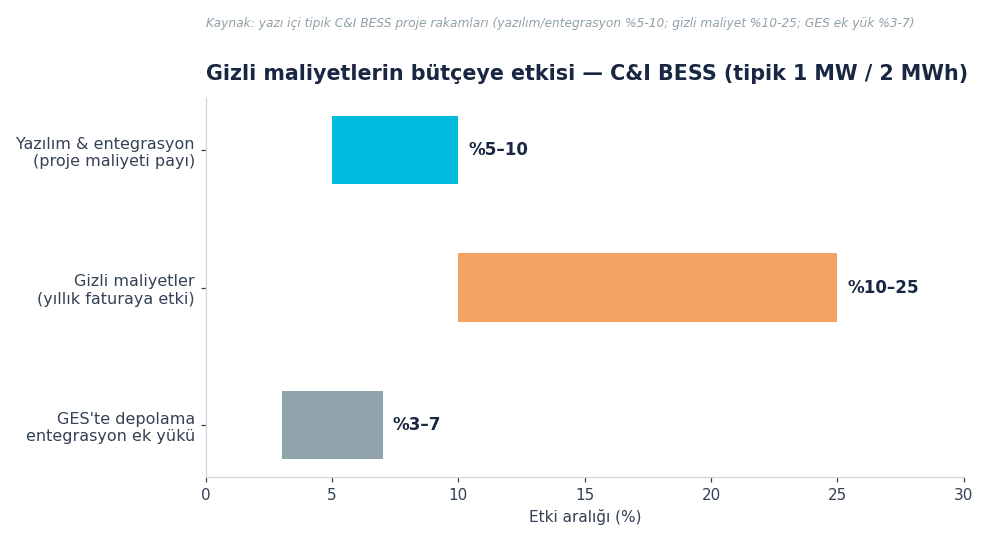
For a factory owner in an OIZ, the primary motivation for a BESS investment is typically demand charge optimization and reducing electricity bills. However, beyond hardware costs, operational expenses that often go unnoticed can derail initial calculations. For a typical C&I facility, the impact of these hidden costs on the annual bill can range from 10% to 25%.
For example, consider a factory with a 2 MW power draw and a monthly electricity bill of 1 million TRY. This facility might aim to reduce its monthly demand charge by 30% with a 1 MW / 2 MWh BESS investment. However, achieving this goal is impossible without proper system integration, real-time data analysis, and dynamic optimization software. The overlooked cost items include:
1. **Advanced BESS Control Software and Integration Costs:** A simple SCADA interface is not enough for efficient BESS management. An advanced Energy Management System (EMS) capable of real-time demand forecasting, market price analysis (spot market, YEKDEM [Renewable Energy Support Mechanism], bilateral agreements), PV generation forecasting, and dynamic discharge/charge planning is essential. This software is critical for extending battery life while ensuring the highest financial return. C&I DERMS solutions like Pulsar automate this optimization, enabling the most efficient operation without human intervention. These software solutions often come with annual subscriptions or performance-based fees. In a typical setup, they can account for 5-10% of the total project cost.
2. **Grid Connection and Compliance Costs:** Adhering to the constantly updated regulations from EPDK (Energy Market Regulatory Authority) and TEİAŞ (Turkish Electricity Transmission Corporation) can incur additional costs. For instance, extra hardware and software modules might be required for reactive power control, frequency regulation capabilities, or cybersecurity standards compliant with grid codes. These compliance costs can mean additional tests, certifications, and even hardware upgrades beyond initial projections. Especially as new regulations, such as the emerging "Grid Flexibility Regulation Draft," begin to demand more active grid services from BESS, these costs will increase.
3. **Data Collection, Analysis, and Storage Infrastructure:** A comprehensive data collection and analysis infrastructure is necessary to monitor BESS performance, train optimization algorithms, and report regulatory compliance. Sensors collecting data every 1-5 seconds, RTUs (Remote Terminal Units), and secure cloud or on-premise server infrastructure to store this data are often overlooked but significant investments. Analytical tools and human resources are also needed to process this data and transform it into meaningful reports.
4. **Cybersecurity and Remote Access Security:** As BESS becomes part of critical infrastructure, protecting them against cyberattacks becomes mandatory. Investing in industrial cybersecurity solutions (firewalls, intrusion detection systems, encryption protocols) for remote access, data transfer, and control systems is an unbudgeted but vital cost. The integration of OT (Operational Technology) and IT (Information Technology) networks, in particular, requires specialized expertise in this area.
5. **Maintenance, Service, and Software Update Contracts:** Battery technology evolves rapidly, and software algorithms are constantly updated. Software updates that optimize battery life, security patches, and periodic maintenance services are a significant part of the annual operational cost. This item is often not included in the initial investment cost or is underestimated. However, outdated software can lead to premature battery degradation, inefficient operation, and consequently, an extended payback period.
The graph below illustrates how the share of software and integration in the total cost distribution of a typical 1 MW / 2 MWh C&I BESS project is often overlooked, and how this impacts the payback period. As can be seen, with a hardware-only approach, the gap between the project's true cost and return significantly widens.
For PV Producers: New Agendas Brought by Storage Integration
For PV (Photovoltaic) power plant owners, storage systems are becoming a strategic tool to prevent revenue loss when generated energy cannot be fed into the grid (due to curtailment, negative prices) or to earn additional income by providing grid services. However, this integration also brings its own unique costs and operational challenges.
Key issues encountered in PV storage integration:
* **Efficient Charge/Discharge Strategies:** Determining the most profitable charge/discharge strategy by understanding the dynamic relationship between YEKDEM prices, spot market prices, and consumption profiles requires advanced algorithms. A simple control system that merely tracks PV generation misses opportunities arising from market fluctuations. Utility-scale DERMS solutions like Quasar help maximize PV owners' revenue by managing these complex market dynamics. * **Capacity Allocation Management:** PV plants with storage systems can be more flexible in grid capacity allocation and usage. However, accurately managing this flexibility, complying with instantaneous instructions from TEİAŞ, and preventing potential penalties require precise control and reporting mechanisms. * **Hybrid Plant Optimization:** In hybrid plants where PV and BESS operate together, an integrated energy management system is essential for the most efficient use of both resources. For example, instantaneous optimization of scenarios such as directly transferring surplus PV generation to BESS or supporting grid-drawn energy with BESS is critical for revenue maximization.
A PV investor must also consider the software, integration, and data infrastructure costs mentioned above when integrating a storage system. These costs can add an additional 3-7% to the total PV investment but will more than pay for themselves in the long run by minimizing revenue losses and creating additional revenue opportunities.
For Investors and Storage Operators: Risk Reflected in Price
For funds investing in BESS projects or storage operators, financial feasibility and risk management are priorities. Hidden costs directly impact a project's Internal Rate of Return (IRR) and Net Present Value (NPV). The greatest risk for an investor is the project failing to deliver the expected returns.
Key points overlooked by investors:
* **Financial Modeling of Operational Risks:** Operational risks such as inefficient battery operation due to lack of software, penalties arising from grid incompatibilities, or cybersecurity breaches are often not adequately represented in financial models. Accurately pricing these risks ensures a more realistic investment decision. * **Technological Obsolescence and Compliance:** Battery technology and energy market regulations are rapidly changing. It is important for investors to invest in 'future-proof' solutions on the software and hardware side to ensure the system can adapt to future technological advancements and regulatory changes. This means choosing modular, upgradable, and scalable systems. * **Performance Guarantees and SLAs:** Performance guarantee agreements (Service Level Agreements - SLAs) with software providers ensure the system operates at expected efficiency. While these agreements have a cost, they reduce operational risk for the investor and protect the project's financial health.
As storage operators manage multiple BESS assets, they need solutions, such as a centralized algorithmic framework like E-Hub, that optimize the performance of all assets and allow for management from a single point. This both reduces operating costs and maximizes portfolio-based returns.
What's Changing in Engineering: From Hardware-Centric to Software-Centric
In the engineering and commissioning phase of a BESS project, hardware selection and physical installation are usually prioritized. However, the hidden cost items mentioned above require engineering teams to shift their perspective: from a hardware-centric approach to a software and integration-centric approach.
What engineering teams need to pay attention to:
* **OT/IT Integration and Data Architecture:** In a BESS project, the integration between Operational Technology (OT) components like battery management systems (BMS) and inverter controllers (PCS), and Information Technology (IT) components like energy management systems (EMS) and cloud-based data analytics, is vital. The seamless communication between these two worlds, and the security and speed of data flow, directly impact project success. Engineers must plan this integration correctly from the outset and consider cybersecurity vulnerabilities. * **Algorithm and Control Logic Design:** Engineers must understand not only the physical connections of BESS but also the control algorithms that determine how it will charge/discharge in different scenarios, how it will react to market signals, and how it will preserve battery life. This is an area that requires machine learning-based forecasting and optimization algorithms, going beyond standard PID controllers. * **Testing and Validation Processes:** It is not enough for BESS to simply pass factory tests. Comprehensive test scenarios and simulations must be applied to test and validate how it performs under real-world conditions, with real-time market data and grid fluctuations. These tests reveal whether the software delivers the expected performance and uncovers hidden errors.
At N2N, we work with our engineering teams to fill these integration and software layer gaps with our hardware-agnostic solutions like Pulsar Edge and Quasar RTU. Our goal is not just to install batteries, but to transform them into smart, efficient, and future-ready energy assets.
The Road Ahead and the Role of Smart Storage Systems
As Turkey's energy transformation accelerates, storage systems will be a key player in this transition. However, for these investments to be sustainable and profitable, we must account for hidden cost items such as software, integration, cybersecurity, and operational support, rather than just focusing on hardware costs.
In the coming period, smart energy management systems (DERMS) for C&I facilities and PV owners will evolve from being merely a cost item to a strategic asset that accelerates investment returns and creates additional revenue opportunities. At N2N, with our Photon, Pulsar, and Quasar product families, we aim to combine this smart energy management with the principles of "Mathematics of Energy," offering our customers not just hardware but also a smart and profitable energy future. Investors now need to invest not only in battery capacity but also in the intelligence that will manage this capacity most efficiently.
We describe how we address this on the product side here: BESS Monitoring & Optimization.